
 Español
 中文
中文 русский
The difference between Siemens programmable controller LME11 and LME22 and common models
2025-07-31 15:53:34
Siemens' LME11 and LME22 are classic models of burner program controllers (Burner Control Units), widely used for safety control in gas/oil burners. Both belong to the LME series, but differ in functionality, application scenarios, and expandability.
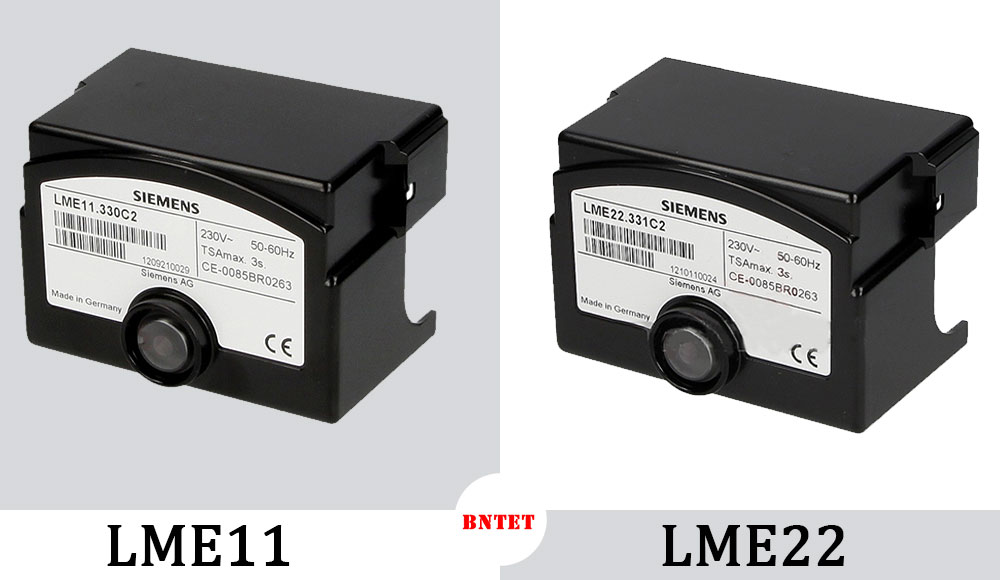
1. Siemens LME11 Burner Program Controller
Key Features
Basic control function: Suitable for single-stage burners (ON/OFF control), does not support multi-stage or proportional regulation.
Flame detection methods:
UV sensor (LME11.11B)
Ionization electrode (LME11.31B)
Safety standards: Complies with EN 298 (gas burner standard).
Applicable fuels: Gas (e.g., natural gas, LPG) or oil (requires additional components).
Typical applications: Small commercial boilers, water heaters, hot air furnaces, and other simple combustion systems.
Common Models
| Model | Flame Detection | Fuel Type | Remarks |
|---|---|---|---|
| LME11.11B | UV sensor | Gas | Most commonly used |
| LME11.31B | Ionization electrode | Gas | For applications without UV detection |
2. Siemens LME22 Burner Program Controller
Key Features
Advanced control function: Supports two-stage combustion control (high/low fire switching), suitable for equipment requiring adjustable combustion intensity.
Flame detection methods:
UV sensor (LME22.11B)
Ionization electrode (LME22.31B)
Safety standards: Complies with EN 298 (gas) and EN 230 (oil).
Applicable fuels: Gas or oil (requires additional modules).
Typical applications: Medium-sized industrial boilers, heat treatment equipment, drying systems, etc.
Common Models
| Model | Flame Detection | Fuel Type | Remarks |
|---|---|---|---|
| LME22.11B | UV sensor | Gas | Most commonly used |
| LME22.31B | Ionization electrode | Gas | For applications without UV detection |
3. Key Differences Between LME11 and LME22
| Feature | LME11 | LME22 |
|---|---|---|
| Control method | Single-stage (ON/OFF) | Two-stage (high/low fire) |
| Burner type | Small, simple control | Medium, requires adjustable output |
| Flame detection | UV / Ionization electrode | UV / Ionization electrode |
| Oil fuel support | Requires additional module | Requires additional module |
| Typical applications | Commercial boilers, water heaters | Industrial boilers, heat treatment |
4. Selection Guide
Choose LME11:
For burners requiring only ON/OFF control (e.g., small water boilers).
Budget-limited applications without need for adjustable output.
Choose LME22:
For burners requiring two-stage control (e.g., industrial boilers).
Systems with higher combustion efficiency demands or variable load requirements.
5. Notes
Oil burner applications: LME11/LME22 natively support gas; oil burners require additional SQM4/SQM5 oil controllers.
Configuration tool: Siemens SBC (Burner Configuration Software) can be used for parameter setup (more common for LME22).
Alternative models:
LME11 → Can be upgraded to LME71 (more advanced features).
LME22 → Can be upgraded to LME72 or LMV3 (supports proportional control).
For more advanced control (e.g., proportional regulation, communication interfaces), consider the LMV5 series.